The pursuit of self-sufficient life support systems for long-duration missions has driven researchers to explore soilless methods of crop cultivation beyond Earth’s surface. These innovative approaches promise not only to provide fresh food and oxygen for astronauts, but also to pioneer resource optimization technologies that could transform terrestrial agriculture. By harnessing advanced cultivation techniques, engineers and biologists are crafting closed environments that maintain a delicate balance of water, nutrients, and light, all within the confines of a spacecraft or habitat module.
Why Soilless Farming Matters Beyond Earth
Space missions face the twin challenges of limited payload capacity and the impossibility of resupply at will. Transporting bulk agricultural soil and repeated shipments of fresh produce from Earth is both costly and impractical. In response, mission planners have turned to hydroponics and aeroponics, which require no traditional soil and drastically reduce mass. By recycling water and nutrients in a closed-loop system, these techniques drastically cut down on waste and conserve precious resources.
Meeting the crew’s nutrition requirements is critical. Freshly grown greens provide vitamins, minerals, and dietary fiber that are often lacking in prepackaged meals. Moreover, the act of tending living plants contributes positively to crew morale and psychological well-being, offering a sense of connection to nature in an otherwise sterile environment. The cultivation units also double as part of the life support architecture, recycling carbon dioxide exhaled by astronauts into oxygen through photosynthesis, thus reinforcing the concept of an integrated ecosystem.
Key Technologies: Hydroponics, Aeroponics, and Beyond
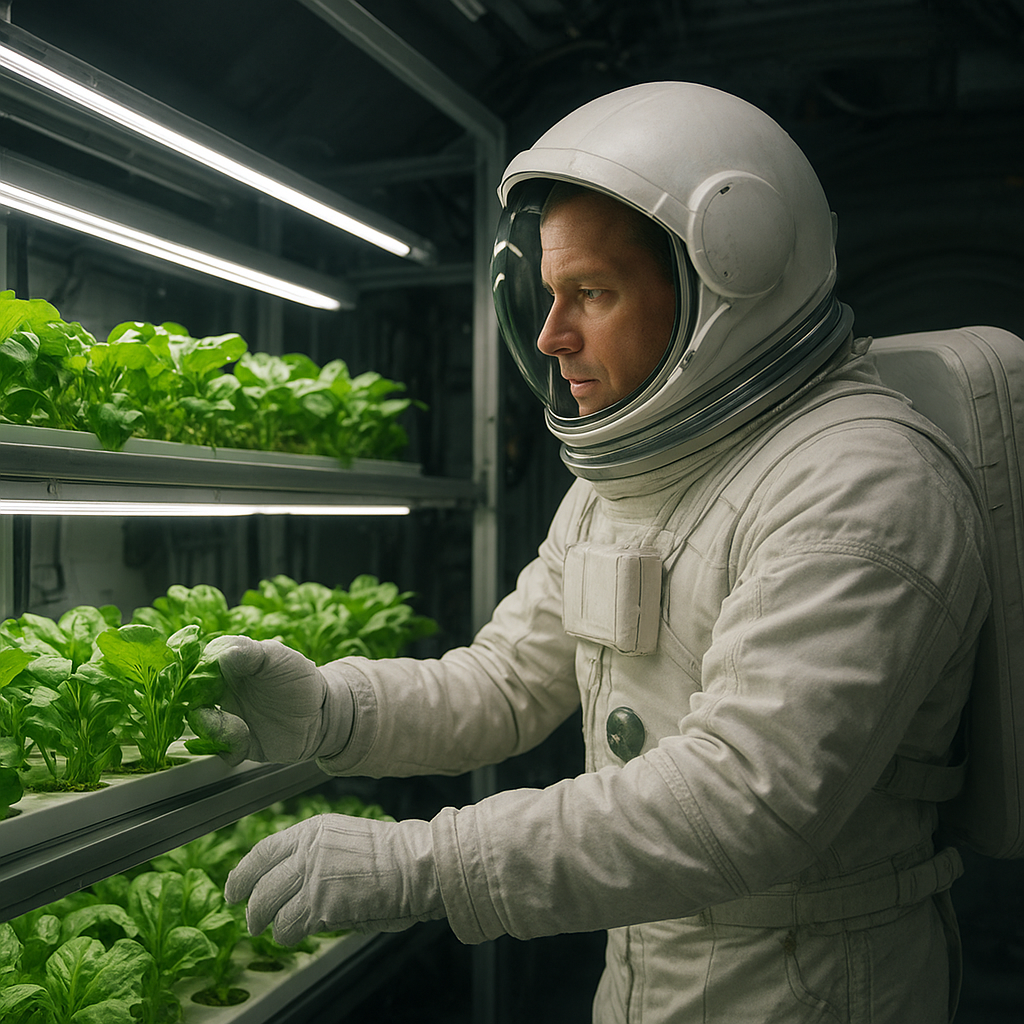
Several approaches have matured under the umbrella of soilless cultivation. Hydroponics systems circulate nutrient-enriched water around plant roots, often employing nutrient film techniques (NFT) and deep water culture (DWC). The constant flow helps maintain oxygen levels while ensuring uniform nutrient distribution.
- In NFT channels, a thin film of water flows along an inclined tray, bathing roots in a nutrient solution.
- DWC setups suspend root bundles in oxygenated reservoirs, fostering robust root development.
Aeroponics takes a different tack by misting roots with a fine spray of nutrient solution. This method boasts exceptional efficiency in water and nutrient usage, often achieving up to 95% lower consumption compared to field agriculture. Without a growth medium, roots remain highly oxygenated, accelerating growth rates and enhancing yield density—an appealing feature when real estate inside a spacecraft is prized.
Emerging variants incorporate LED lighting arrays tuned to optimal wavelengths of red and blue light, maximizing photosynthetic efficiency while minimizing energy draw. Coupled with advanced sensors and automated control systems, these photobioreactors can dynamically adjust pH, temperature, and nutrient concentrations, ensuring ideal conditions even as external circumstances fluctuate.
Challenges and Solutions in Microgravity
Operating cultivation units in microgravity introduces unique hurdles. Without gravity, water no longer flows predictably, leading to waterlogging or uneven nutrient distribution. To counter this, developers have engineered specialized wick systems, capillary mats, and porous growth substrates that channel fluids consistently through capillary action.
Root anchorage also poses a problem when plants have no gravitational direction to guide them. Mesh supports, 3D-printed root baskets, and custom foam inserts help maintain plant orientation and prevent delicate root zones from tangling or collapsing. Enclosures must maintain sterile conditions to forestall microbial blooms that could jeopardize both crop health and crew safety.
Another concern is the absorption of ethylene gas, a byproduct of plant respiration that can accumulate in closed quarters and stunt growth. Advanced filtration and selective venting strategies are thus incorporated to maintain ambient gas composition within optimal thresholds.
Future Prospects and Scaling Up for Deep Space Exploration
As mission profiles extend to Mars and beyond, soilless farms must evolve into fully bioregenerative life support modules capable of handling the rigors of long transit times and planetary surface operations. Prototypes of Martian Greenhouses envision inflatable modules covered in radiation-shielding materials, where crops are grown in layers of treated lunar or Martian regolith supplemented with nutrient solutions.
Researchers are investigating the use of local regolith as a growth medium after detoxification of perchlorates and the addition of organic amendments derived from on-site waste processing. In-situ resource utilization (ISRU) techniques may produce biochar or microbial inoculants to enhance substrate fertility and water retention, making agriculture on Mars a realistic proposition.
Automation remains pivotal. Robotic tenders, equipped with multispectral cameras and AI algorithms, can monitor plant health, adjust nutrient concentrations, and harvest produce with minimal human intervention. This level of innovation is vital for maintaining stable crop yields under the unpredictable conditions of deep-space missions.
Potential Impact on Earth Agriculture
Technologies honed for off-world farming are already seeding breakthroughs in urban sustainability and vertical farming on Earth. Compact hydroponic towers and aeroponic pods are being installed in city rooftops and abandoned warehouses, reducing transportation distances and preserving water in drought-prone regions.
By implementing precision control over nutrient delivery and light exposure, farmers can tailor growth cycles to market demand, minimize pesticide use, and elevate yield consistency. These advancements promise to address food security challenges, optimize resource utilization, and reduce the ecological footprint of agriculture across diverse climates.
The synergies between extraterrestrial and terrestrial agriculture underscore a broader vision: marrying advanced soilless systems with renewable energy and circular waste management to achieve a resilient, planet-friendly food network. As humanity looks to the stars, the lessons learned in orbit will undoubtedly help fortify our farms at home.