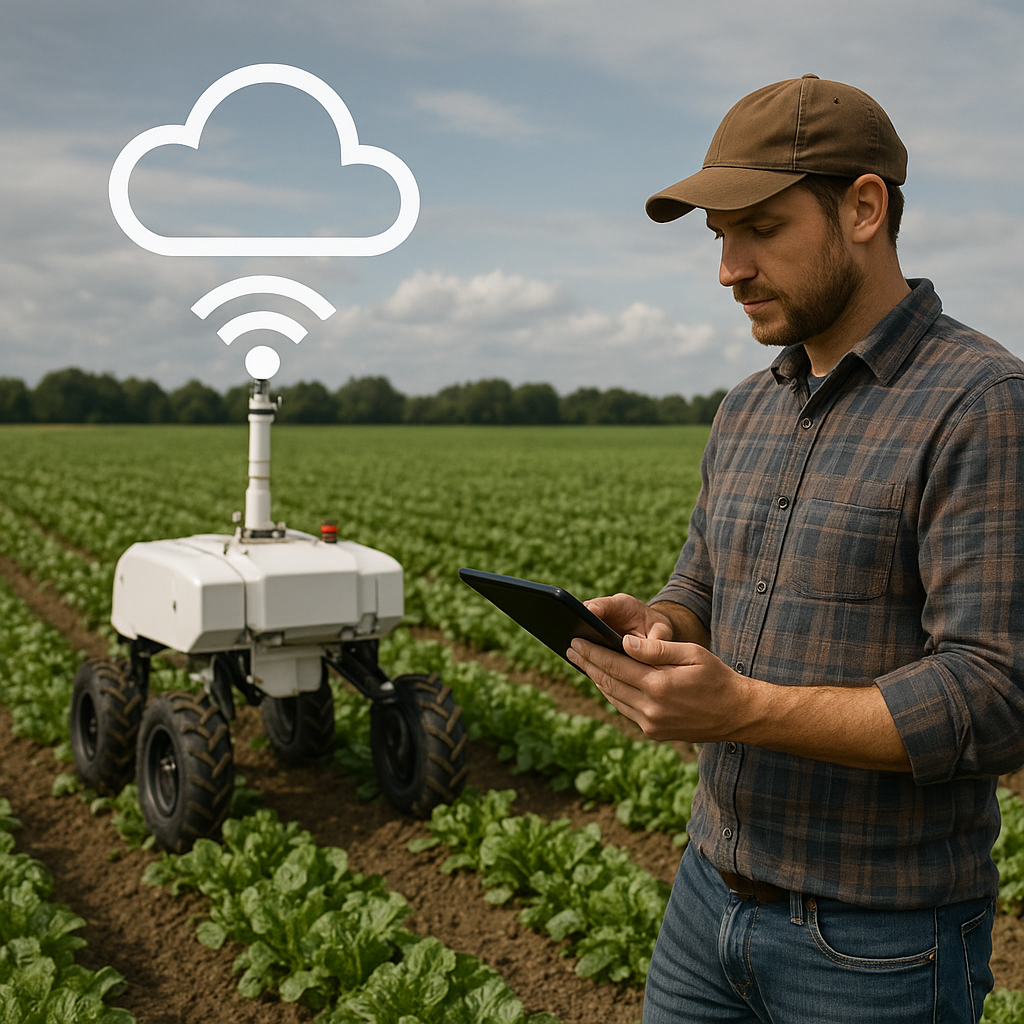
Cloud robotics is transforming modern agriculture by merging advanced robotics with powerful cloud computing. This convergence enables farms to become more efficient, data-driven, and sustainable, allowing producers to address global food demands while reducing environmental impact. From collaborative drones performing crop monitoring to autonomous tractors executing precision tasks, cloud robotics provides next-level capabilities previously limited to industrial settings.
Benefits of Cloud Robotics in Agriculture
The integration of robotics with cloud services offers farmers numerous advantages:
- Precision Farming: Cloud-connected robots can access real-time satellite imagery, soil sensors, and weather forecasts to apply inputs like water, fertilizer, or pesticides only where needed.
- Scalability: Cloud infrastructure allows farms large and small to scale operations without massive local IT investments. Data storage, processing, and fleet coordination occur off-site.
- Cost Reduction: By outsourcing heavy computational tasks to the cloud, on-board hardware requirements for robots are minimized, lowering capital and maintenance expenses.
- 24/7 Operations: Automated machines, overseen via cloud dashboards, can perform tasks at any time, optimizing fieldwork schedules and reducing labor dependency.
- Collaborative Insights: Multiple robots share information through cloud platforms, continuously learning from each other and improving performance across the entire fleet.
Enhanced Crop Monitoring
Unmanned aerial vehicles (UAVs) equipped with multispectral cameras can survey expansive fields in minutes. Through connectivity to cloud servers, images are processed instantly, generating vegetation indices and stress maps. This timely intelligence helps farmers react swiftly to nutrient deficiencies or pest infestations, increasing overall crop health.
Automated Harvesting
Cloud robotics accelerates the adoption of autonomous harvesters. These machines leverage object detection algorithms hosted on cloud platforms to identify fruits and vegetables with high accuracy. Continuous updates to these models ensure that harvesters adapt to different varieties and ripeness levels, maximizing yield.
Key Components and Technologies
Several core technologies underpin successful deployments of cloud robotics in agriculture:
- IoT Sensors: Soil moisture probes, environmental stations, and plant-level detectors gather critical data for decision-making.
- Edge Devices: Lightweight controllers on robots handle safety-critical functions locally, while delegating heavy processing to the cloud.
- High-bandwidth Connectivity: Reliable networks, including 5G and LPWAN, ensure seamless data exchange between field robots and cloud centers.
- Machine Learning Models: Cloud-hosted algorithms process large datasets to predict yields, detect diseases, and optimize resource allocation.
- Blockchain Integration: Secure ledgers track produce from seed to shelf, enhancing traceability and food safety compliance.
Cloud Platforms
Major cloud providers now offer specialized services for agricultural robotics:
- Real-time analytics engines to handle high-frequency data streams from multiple robots.
- Device management suites for orchestrating firmware updates and remote diagnostics.
- API libraries simplifying integration with third-party farm management systems.
Collaborative Robotics (Cobots)
Unlike traditional industrial robots, agricultural automation cobots are designed to work alongside human operators. By leveraging pose estimation and safety monitoring via cloud services, these cobots can assist with tasks like pruning, planting seedlings, or sorting harvested produce.
Implementation Challenges and Strategies
While the benefits of cloud robotics are clear, agricultural adoption faces several hurdles:
- Connectivity Gaps: Remote fields often lack high-speed internet, forcing reliance on satellite or mesh networks that may introduce latency.
- Data Privacy and Ownership: Farmers are concerned about who owns data generated on their land and how it might be used.
- Complex Integration: Legacy equipment and diverse IoT standards complicate seamless communication between devices and cloud platforms.
- Initial Investment: Although cloud services lower hardware costs, the upfront expense for robotic machinery remains significant for many operations.
- Regulatory Compliance: Autonomous vehicles must meet safety and environmental regulations, which vary by region.
Overcoming Connectivity Barriers
Deploying flexible network architectures can mitigate coverage issues. Options include:
- Private LTE/5G networks dedicated to farm operations.
- Low-power wide-area network (LPWAN) for sensor data when high bandwidth isn’t necessary.
- Hybrid solutions that switch between local edge processing and cloud connectivity based on real-time conditions.
Ensuring Data Security
To address privacy concerns, many vendors now offer end-to-end encryption and farmer-controlled data sharing policies. Smart contracts on a blockchain ledger can automate data transactions, ensuring transparency and trust.
Future Outlook and Emerging Trends
The trajectory of cloud robotics in agriculture points toward heightened sustainability and resilience. Key trends include:
- Integration with climate models to forecast environmental risks and adjust planting strategies.
- Autonomous swarm robotics, where dozens of small drones and ground bots coordinate via the cloud to cover larger areas efficiently.
- AI-driven supply chain optimization, connecting farm data directly to processing and distribution channels.
- Robotics-as-a-Service (RaaS) models, offering flexible subscription plans instead of outright purchases.
Precision Livestock Management
Beyond crops, cloud robotics is entering animal husbandry. Automated feeding stations, health monitoring drones, and climate-controlled barns all leverage cloud connectivity to maximize animal welfare and productivity.
Adaptive Farming Ecosystems
The ultimate vision is a smart farm where networks of robots, sensors, and decision-support systems dynamically adapt to changing conditions. By harnessing the full power of cloud computing, predictive analytics, and real-time efficiency metrics, agriculture will continue evolving to meet the food demands of a growing global population.