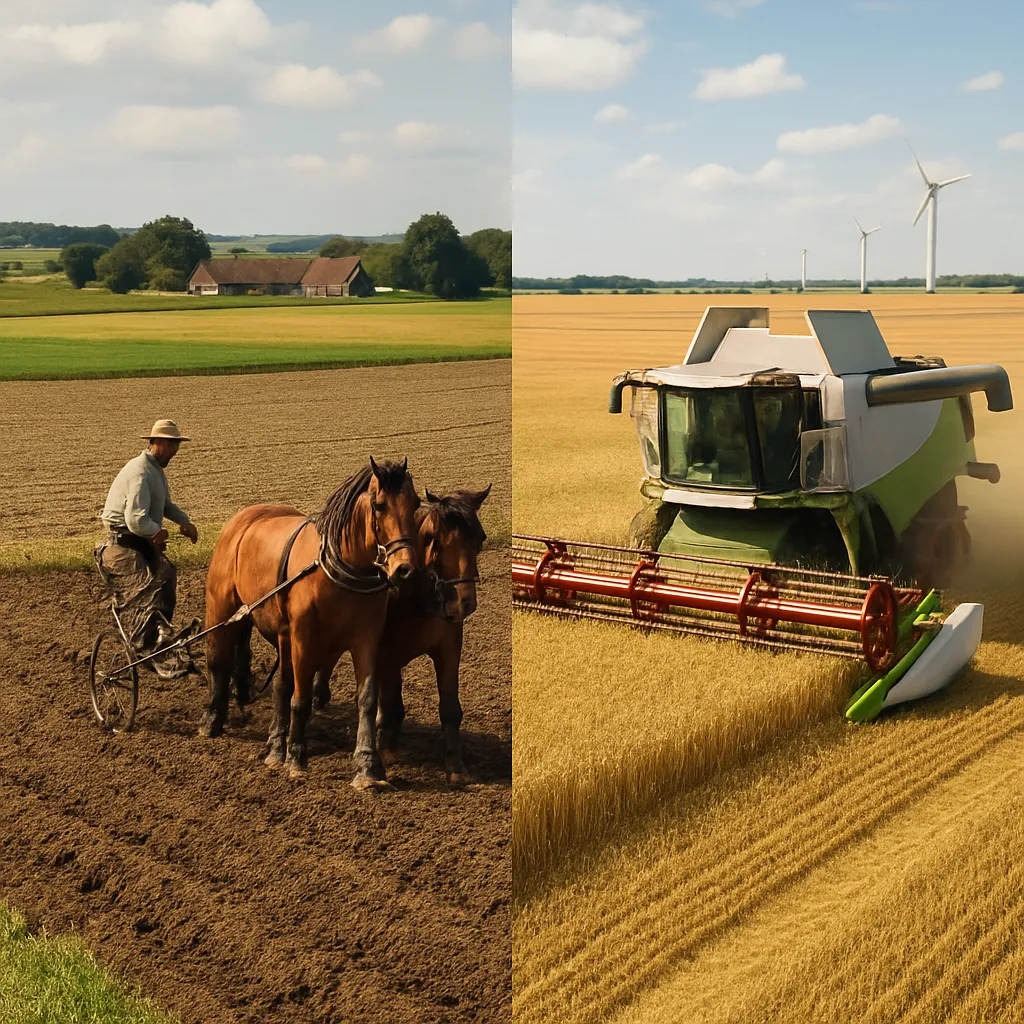
Across Europe, farming is changing faster than at any time in recent history. Generations of families still work the same fields, yet the tools in their hands, the seeds in their soil and the data on their screens look very different from the past. This article explores how traditional and modern farming interact, sometimes in conflict and sometimes in harmony, in order to feed a growing population while protecting landscapes, water and biodiversity. Drawing on shared European farming knowledge, we can see that the future of agriculture is not a simple choice between old and new, but a careful mix of skills, values and technologies that must adapt to climate change, market pressures and social expectations across the continent.
Historical roots of European agriculture
For centuries, European agriculture was based on small, family-run farms relying on human and animal labour. Farmers rotated crops, saved seed and used manure and compost as natural fertiliser. Many systems were adapted to local climates and soils, such as Mediterranean olive terraces, mountain pastures in the Alps and mixed arable-livestock farms in Central and Eastern Europe. These systems created complex rural cultures, dialects and festive traditions linked to sowing, harvest and livestock breeding. While production levels were modest by today’s standards, these farms formed the backbone of food supply and rural life, and they still shape the cultural identity of many regions.
Defining traditional farming
Traditional farming in Europe is usually characterised by small or medium farm size, mixed crop and livestock systems, and reliance on family labour. Many traditional farms use local or heritage breeds and varieties that are well adapted to their environments and resistant to regional pests or weather patterns. Inputs such as chemical fertilisers, synthetic pesticides or imported animal feed are used in limited amounts or not at all. Knowledge is transmitted across generations through practice, observation and local customs, rather than formal training alone. Traditional farms tend to maintain hedgerows, stone walls, small woodlots and ponds, which create diverse habitats for birds, insects and wild plants.
Key strengths of traditional farming
One major strength of traditional agriculture is its close connection to local ecosystems. By respecting natural cycles and relying on diversified production, these farms can be more resilient to shocks such as price fluctuations or specific pest outbreaks. Heritage breeds of cattle, sheep and goats, as well as traditional grain and vegetable varieties, often tolerate harsh conditions better than highly specialised modern lines. Traditional farms also maintain rural employment and social cohesion, as they rely on family and community cooperation. Many tourists seek out landscapes shaped by traditional farming, supporting rural economies through agritourism and demand for regional products such as cheeses, cured meats, wines and artisanal preserves.
Limitations and challenges for traditional farmers
Despite their cultural and ecological value, traditional farms face serious economic pressures. Lower yields per hectare and limited access to capital make it hard for small farmers to compete with large, mechanised operations. Young people may leave rural areas in search of better incomes and urban lifestyles, leading to an ageing farming population and labour shortages. Fragmented land ownership, with many small plots, increases costs and reduces efficiency. Traditional knowledge alone is sometimes insufficient to handle new plant diseases or extreme climate events. Without policy support, certification schemes or niche markets, many traditional farms struggle to remain financially sustainable and risk abandonment or conversion to more intensive systems.
What defines modern farming in Europe
Modern European farming typically involves high levels of mechanisation, improved plant varieties and specialised livestock breeds designed for rapid growth or high yields. Tractors, combine harvesters and precision seeders allow farmers to cultivate large areas with relatively few workers. Synthetic fertilisers and plant protection products are used to optimise growth and manage weeds, insects and diseases. Many modern farms are integrated into global supply chains, selling grain, meat, milk or vegetables to processors and retailers that operate across borders. Data-driven decision making, based on sensors, satellite images and software tools, is becoming an integral part of modern farm management.
Technologies transforming modern farms
Current technological change in agriculture is often described as a digital and biological revolution. Precision farming uses GPS-guided machinery to apply fertilisers and pesticides only where needed, reducing waste and environmental impact. Drones and satellite imagery help monitor crop health, soil moisture and pest pressure across large areas. Robotics is gradually entering European fields and barns, from robotic milking systems in dairy farms to automatic weeders and harvesters in vegetable and fruit production. Biotechnological advances include improved crop varieties created through sophisticated breeding techniques designed to tolerate drought, salinity or specific diseases, while enhancing yield and quality.
Advantages of modern, technology-driven systems
Modern farming has dramatically increased productivity, allowing Europe to become a major exporter of many agricultural products and to ensure a stable food supply. Higher yields reduce the amount of land needed to feed the population, potentially leaving more space for forests, wetlands and conservation areas. Mechanisation reduces the physical burden on farmers and can improve safety. Data-driven management helps optimise the use of water, fertilisers and feed, which can lower costs and emissions per unit of product. Modern storage, processing and logistics systems reduce post-harvest losses, delivering a wide variety of foods to consumers at relatively low prices throughout the year.
Risks and downsides of intensive modern farming
At the same time, intensive production systems can generate serious environmental and social problems if not managed carefully. Overuse of fertilisers and pesticides may pollute rivers, lakes and groundwater, harming aquatic life and drinking water quality. Monocultures and removal of hedges or grass strips reduce biodiversity and make fields more vulnerable to pests and climatic extremes. Heavy machinery can compact the soil, while large livestock operations may emit significant greenhouse gases and odours. Socially, consolidation of farms into larger units can reduce rural employment and weaken community ties. Many consumers also worry about animal welfare in highly industrialised systems, pushing for new regulations and market standards.
Environmental dimensions: soil, water and biodiversity
Comparing traditional and modern farming requires looking at environmental outcomes in specific contexts. Traditional mixed farms tend to maintain more landscape diversity and wildlife habitats, supporting pollinators, birds and small mammals. Their lower input levels reduce the risk of chemical contamination, but in some cases may lead to nutrient depletion or erosion if land is overworked without proper rest. Modern farms can be environmentally efficient when they apply precision techniques, conservation tillage and carefully designed crop rotations. However, if driven only by short-term profit, they may intensify production in ways that degrade soil structure, overuse water resources and accelerate biodiversity loss over time.
Economic efficiency and market pressures
From an economic perspective, modern farms often show higher efficiency per unit of labour, capital and land, especially for commodities like wheat, maize or pork. Access to finance, insurance and advanced machinery gives them an advantage in volatile markets. Traditional farms, however, can capture value through product differentiation, including protected geographical indications, organic certification and direct sales to consumers. Farmers’ markets, community-supported agriculture and local processing add value to small volumes of high-quality products. Public policies, especially within European frameworks, also influence economic outcomes by providing subsidies, environmental payments or rural development funds that can support both traditional and modern approaches.
Social and cultural dimensions of farming styles
The social role of farming goes beyond food production. Traditional farms often act as centres of rural culture, preserving local dialects, music, crafts and cuisine. Seasonal work creates rhythms that shape community life, from harvest festivals to transhumance events where animals move between winter and summer pastures. Modern large-scale farms may employ fewer people but can provide stable, skilled jobs in machinery operation, veterinary care, logistics or digital services. Training institutions and advisory networks have grown around them, promoting innovation. The challenge lies in ensuring that technological progress does not erase cultural heritage, but instead supports new forms of rural identity and cooperation.
Animal welfare and livestock management
Livestock farming reveals clear contrasts between traditional and modern systems. Traditional farms usually keep smaller herds or flocks with access to pasture, allowing more natural behaviour and varied diets. Local breeds may produce less meat or milk but are well adapted to local conditions, reducing veterinary interventions. Modern livestock systems can provide controlled environments that protect animals from weather extremes and predators, while automated feeding and health monitoring can improve performance and early disease detection. However, high stocking densities and restricted movement raise ethical concerns. European citizens increasingly demand higher welfare standards, pushing both traditional and modern farmers to adapt housing, transport and slaughter practices.
The role of innovation in traditional systems
Innovation is not limited to high-tech, large-scale farms. Many traditional farmers adopt selected modern tools while preserving their overall way of life. For example, a small vineyard might use GPS mapping for precise fertiliser application while still harvesting grapes by hand. A mountain sheep farmer may employ mobile phone apps to track weather and market prices while maintaining transhumance routes. Renewable energy technologies such as solar panels or small biogas units can support self-sufficiency. Combining traditional ecological knowledge with modern scientific insights often leads to creative, site-specific solutions that enhance both productivity and resilience.
Organic and agroecological approaches as a bridge
Organic farming and broader agroecological approaches can serve as bridges between traditional and modern agriculture. They often revive crop rotations, intercropping and natural pest control methods, while relying on scientific research to design efficient systems. Many organic producers use modern machinery, careful management of nutrients and professional marketing strategies. These farms seek to reduce external inputs, protect soil health and foster biodiversity while remaining commercially viable. Certification and labelling allow consumers to support such practices, creating new market opportunities. Across Europe, organic and agroecological initiatives are growing on both small family farms and larger enterprises.
Digital agriculture and the future farmer’s skills
The spread of digital tools is changing the profile of the European farmer. Skills in data analysis, software use and sensor interpretation become as important as traditional abilities in soil assessment or animal handling. Young farmers entering the sector are often more open to experimentation with apps, online platforms and farm management systems. At the same time, older farmers possess deep experiential knowledge of their land, weather patterns and local social dynamics. Intergenerational cooperation, mentoring and training programmes can help merge these strengths, ensuring that digital agriculture builds on, rather than replaces, accumulated wisdom about farming environments.
Climate change and adaptation strategies
Climate change adds urgency to the debate between traditional and modern farming. More frequent droughts, heatwaves, floods and unpredictable seasons threaten yields and stability. Traditional diversified systems may buffer some risks by spreading production across different crops and animals, while deep-rooted local varieties can cope with specific stresses. Modern breeding, irrigation and forecasting technologies offer additional tools, but also require investment and careful management to avoid overuse of water or energy. European policies increasingly promote climate-smart agriculture, encouraging carbon sequestration in soils, reduced emissions and resilient landscapes that combine trees, crops and pasture in integrated systems.
Policy frameworks shaping European agriculture
Public policy strongly influences whether traditional or modern models dominate in any given region. Support schemes, environmental regulations and rural development programmes can either encourage intensification or reward landscape stewardship and small-scale production. Payments for maintaining permanent grassland, hedgerows or high-nature-value farming areas help protect traditional systems that provide public goods beyond food. Investment grants may prioritise modern technologies such as precision equipment, storage facilities or digital infrastructure. The balance of these measures shapes farmers’ choices, land use patterns and the evolution of villages and small towns across the continent.
Complementarity rather than opposition
Instead of seeing traditional and modern farming as rigid opposites, it is more realistic to treat them as ends of a spectrum. Many farms operate in the middle, using tractors and improved seeds while keeping mixed production and strong family involvement. Regions with intensive arable production may still contain traditional orchards or pastoral systems. Cooperation networks, producer groups and knowledge-sharing platforms allow farmers with different approaches to learn from each other. Ultimately, feeding Europe sustainably will depend on combining high-tech efficiency where appropriate with context-sensitive, place-based practices that draw on long histories of working with the land.
Conclusion: towards an integrated European farming future
The comparison between traditional and modern farming in Europe reveals tensions but also possibilities for synthesis. Traditional systems offer cultural richness, landscape diversity and resilience rooted in local adaptation. Modern systems deliver high productivity, technological innovation and integration into global food networks. The challenge is not to choose one over the other, but to design frameworks where they can reinforce each other. By protecting local breeds and varieties, investing in digital and biological research, supporting fair markets and recognising the social value of farming, Europe can build an agricultural future that is productive, environmentally responsible and socially just. In that future, the most valuable tools will be not only machines or chemicals, but also resilience, biodiversity, stewardship, adaptation, knowledge, innovation, sustainability, heritage, cooperation and equity in how land and resources are used and shared.
