Implementing low-cost solar chillers on dairy farms offers a pathway to enhanced sustainability, significant energy savings, and improved milk quality. By harnessing renewable energy and optimizing cooling processes, farm operators can lower operating expenses while meeting the stringent requirements for milk storage temperatures. This article explores the technology behind solar chillers, practical design considerations, economic outlook, and real-world examples demonstrating successful integration in agricultural settings.
Advantages of Solar-Driven Cooling for Dairy Operations
Dairy farms require reliable and efficient refrigeration to maintain the freshness and safety of milk. Traditional grid-powered chillers can impose high energy costs, especially during peak demand periods. Solar-powered chillers address these challenges through:
- Reduced utility expenses by offsetting electricity consumption with photovoltaic generation.
- Enhanced resilience against grid outages, ensuring continuous cooling for sensitive dairy products.
- Lower greenhouse gas emissions, contributing to farm-level carbon footprint reduction and compliance with environmental standards.
- Potential for on-site energy storage, leveraging thermal batteries or ice storage to manage diurnal load variations.
Furthermore, integrating solar chillers can improve the overall energy profile of a dairy farm, attracting positive interest from sustainability-conscious consumers and agri-food certification programs.
Technical Components and System Architecture
Photovoltaic Array and Power Electronics
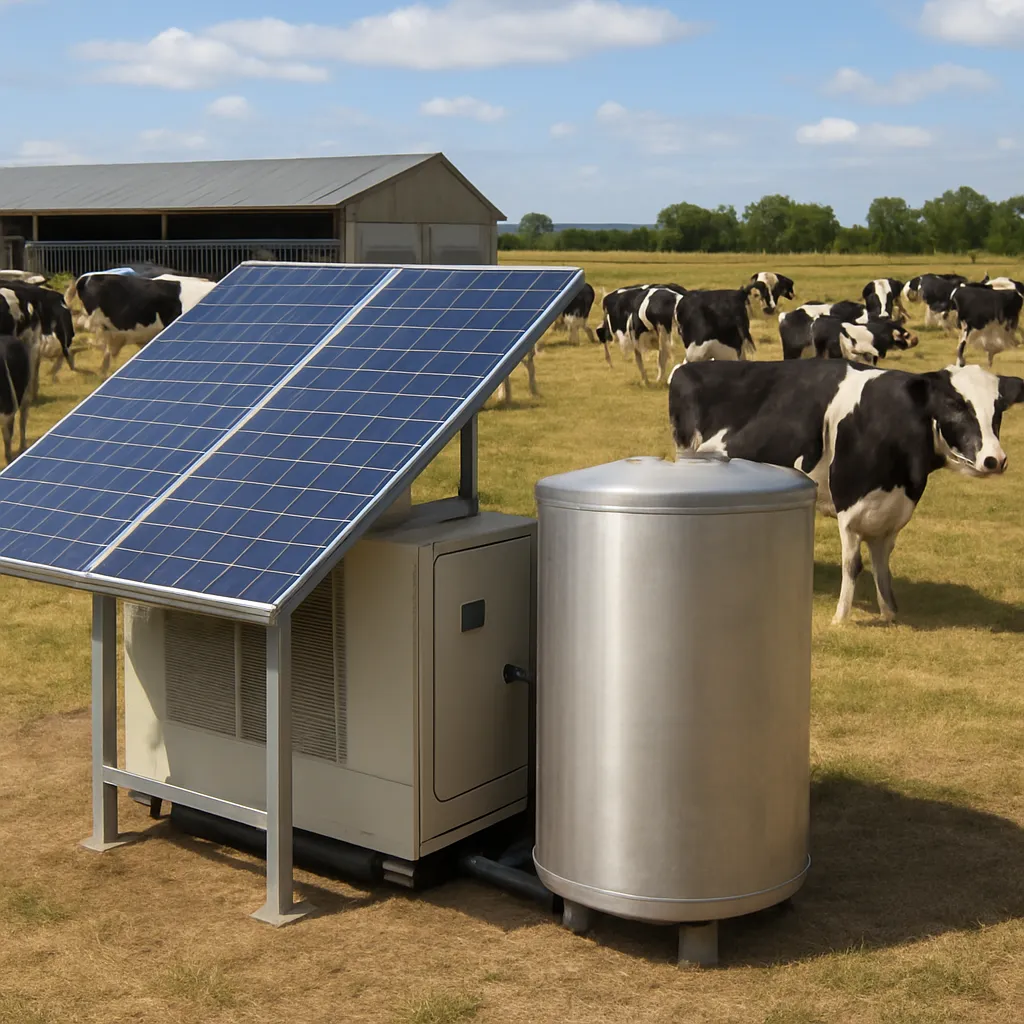
The core of any solar-powered cooling system is the solar photovoltaic (PV) array. Selecting appropriate modules involves evaluating:
- Rated capacity (Watt-peak), matched to chiller load requirements.
- Module efficiency and temperature coefficient for optimal performance in high-heat farm environments.
- Durability, warranty, and resistance to mechanical stress such as hail or dust.
Power electronics, including Maximum Power Point Tracking (MPPT) inverters and charge controllers, maximize energy harvest. Proper sizing of the inverter ensures continuous operation of variable-speed compressors and pumps essential for precise temperature control.
Chiller Technology and Refrigeration Cycle
Solar chillers may utilize vapour-compression or absorption refrigeration cycles. Key considerations include:
- Choice of refrigerant: Opt for low global warming potential fluids compatible with farm safety standards.
- Compressor selection: Scroll or variable-frequency drive (VFD) compressors enable adjustable cooling capacity and improved efficiency.
- Heat exchangers: High-performance evaporators and condensers reduce pressure drops and increase overall system COP (Coefficient of Performance).
Innovative designs employ thermal energy storage, such as ice or chilled water tanks, to decouple PV output fluctuations from cooling demand. During peak solar hours, excess power freezes water into ice; later, the stored ice provides cooling when sunlight wanes.
Design Considerations for Dairy Farm Integration
Load Assessment and Thermal Demand Profiling
A comprehensive evaluation of cooling loads is crucial. Dairy operations typically require:
- Bulk milk tank refrigeration to maintain 2–4°C temperatures.
- Milk parlour equipment cooling, including plate coolers and bulk milk pumps.
- Ambient climate control for storage rooms and packaging areas.
Detailed monitoring of hourly temperature and load patterns allows system designers to match chiller capacity to real demand, avoiding over-sizing and unnecessary capital expenditure.
Site Layout and Orientation
Optimal placement of PV panels enhances energy production. Key factors include:
- Roof versus ground-mount installations: Balancing available space and structural load constraints.
- Tilt angle and azimuth alignment: Maximizing annual irradiation capture.
- Shade analysis: Avoiding nearby trees, silos, or barns that could cast shadows.
Integrating panels on existing farm buildings can reduce land use conflicts and simplify wiring runs to the chiller skid locations.
Water Management and Quality Control
Many dairy farms rely on on-site water for both cleaning tasks and chiller operation. Maintaining water quality prevents scale buildup in evaporators and condensers. Strategies include:
- Pre-filtration systems to remove particulates.
- Chemical treatment to control pH and inhibit corrosion.
- Regular maintenance protocols for pumps and valves to ensure consistent flow rates.
Economic Viability and Return on Investment
Capital Costs and Incentive Programs
Initial investment includes PV modules, inverters, chiller units, piping, and installation labor. Average cost ranges from $1,200 to $1,800 per kW of installed solar capacity, plus chiller system expenses. However:
- Federal and state-level tax credits or grants can offset up to 30–50% of capital costs.
- Renewable Energy Certificates (RECs) and carbon credit programs may generate additional revenue streams.
- Low-interest loans through agricultural development agencies further reduce upfront financial burdens.
Operational Savings and Payback Period
Electricity costs on dairy farms can amount to thousands of dollars monthly during the summer. By generating on-site renewable power, farms may cut utility bills by 60–80%. Typical payback periods for solar chiller installations range between 4 and 8 years, depending on:
- Local energy prices and demand charges.
- Solar resource availability at the farm location.
- Scale of the installation—larger systems benefit from economies of scale.
Long-term warranties on PV modules (25 years) and inverters (10–15 years) provide assurance of sustained performance, while modular expansion options allow capacity upgrades as dairy operations grow.
Real-World Implementations and Lessons Learned
Case Study: Family-Owned Dairy in California
A mid-sized dairy farm in Central California installed a 100 kW solar PV array paired with a 20-ton chilling unit. Key outcomes included:
- Annual generation of 180,000 kWh, covering 75% of the farm’s cooling load.
- Annual savings of $25,000 in electricity costs, shortening payback to 5 years.
- Reduction of 120 metric tons of CO2 emissions annually.
The farm’s management highlighted the importance of engaging experienced installers and scheduling routine maintenance during the mild winter season to ensure uninterrupted performance.
Case Study: Cooperative Dairy Processing Plant
A dairy cooperative in the Midwest retrofitted an existing chiller room with a solar-assisted absorption chiller. Benefits included:
- Integration with heat recovered from the boiler, enhancing overall system efficiency.
- Improved temperature stability within the processing line, leading to higher product consistency.
- Scalable design that allowed subsequent addition of PV capacity as membership expanded.
One challenge encountered was managing the transient response of absorption chillers under fluctuating solar input—a challenge addressed through dynamic control algorithms and a small backup electric compressor.
Future Outlook and Innovations in Dairy Farm Cooling
Ongoing research in materials science and control systems is driving new breakthroughs:
- Advanced phase-change materials (PCMs) for enhanced thermal storage density.
- Smart inverters with artificial intelligence for predictive performance optimization.
- Hybrid systems combining solar, wind, and biogas to create fully autonomous microgrids.
As sustainability standards tighten and energy prices rise, the adoption of low-cost solar chillers on dairy farms is poised to accelerate, offering both economic and environmental dividends for the agricultural sector.