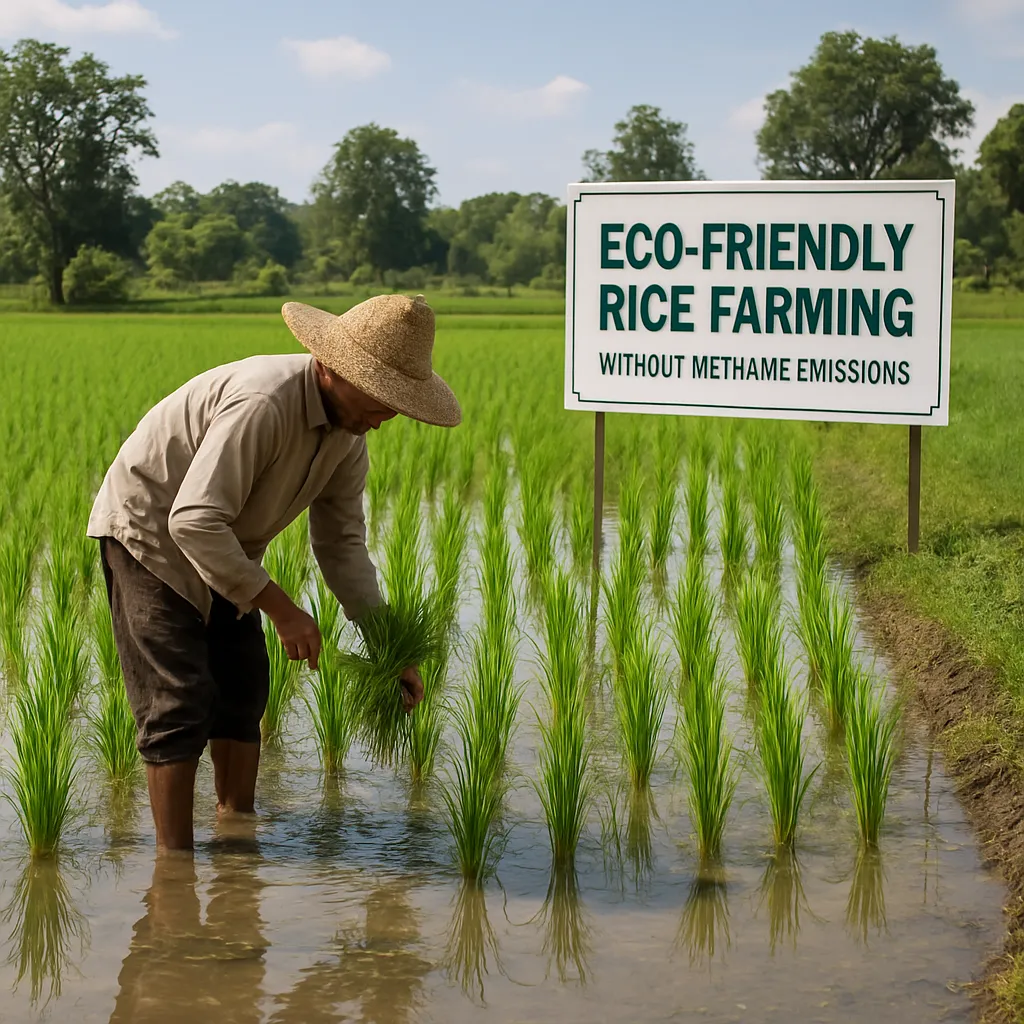
Rice cultivation is one of the most water-intensive and greenhouse gas–emitting agricultural systems, largely due to continuous flooding that produces significant methane emissions. However, innovative practices are emerging that enable farmers to grow rice with minimal environmental impact while maintaining or even increasing yields. By integrating novel cultivation techniques, soil amendments, biological treatments, and supportive policies, the sector can become more sustainable and climate-resilient.
Water Management through Alternate Wetting and Drying
Alternate Wetting and Drying (AWD) is a practical irrigation method that reduces methane release by periodically allowing paddy soils to dry before re-flooding. This wet-dry cycle increases soil oxygen, inhibiting the anaerobic conditions necessary for methane-producing microbes. Key benefits of AWD include improved water use efficiency, reduced greenhouse gas emissions, and sustained rice productivity. Farmers can implement AWD with minimal additional costs or infrastructure.
- Monitor water depth using simple field water tubes or perforated pipes.
- Drain fields when the water level is 15–20 cm below the soil surface.
- Re-flood fields only when the soil cracks or water stress appears in the rice plants.
- Maintain regular irrigation during sensitive growth stages to avoid yield loss.
Successful AWD adoption requires training on accurate water-level measurement and agronomic timing. In regions with limited water supply, farmers can increase resilience to drought while cutting down on methane by up to 50–70% compared to continuous flooding.
Acid Soil Amendments and Enhanced Varieties
Soil characteristics greatly influence methane dynamics. Highly reduced, acid soils tend to foster methane production, while well-aerated, alkaline soils suppress it. Applying carbon-rich amendments and lime can shift soil pH and redox potential, further mitigation of emissions. Organic residues, biochar, and compost not only enhance soil fertility but also sequester carbon in stable forms.
Parallel to soil amendments, breeding and dissemination of improved rice genotypes offer an additional pathway to low-emission farming. New varieties engineered for deeper root systems and efficient nitrogen uptake can:
- Shorten the crop’s anaerobic period.
- Reduce biochemical pathways that generate methane.
- Increase grain yield under AWD conditions.
- Enhance stress resilience to salinity and intermittent waterlogging.
Integrating these high-performance varieties with tailored soil management leads to synergistic gains in yield and environmental quality. Field trials have demonstrated yield increases of 5–15% alongside 40% lower methane output.
Biological Approaches and Soil Microbiome Enhancement
A burgeoning area of research focuses on leveraging the soil biodiversity to combat greenhouse gas emissions. By inoculating paddies with methane-oxidizing bacteria or promoting native populations, farmers can naturally curb methane before it escapes into the atmosphere. Such methanotroph enrichment can be achieved through:
- Introducing organic substrates that favor methanotroph growth over methanogens.
- Applying consortiums of beneficial microbes in seed coatings or field biofertilizers.
- Implementing crop rotations that support soil microbial balance, such as alternating rice with legumes.
Complementary measures, like conservation tillage and cover cropping, improve soil structure, increase organic matter, and foster a robust microbial community. In one pilot program, microbial inoculants reduced methane emissions by an additional 20% when used in conjunction with AWD. These biological strategies also elevate nutrient cycling, augment plant health, and minimize dependency on synthetic fertilizers.
Policy Frameworks and Farmer Adoption Strategies
Translating scientific innovations into widespread practice hinges on effective policy design, knowledge dissemination, and economic incentives. Governments, research institutions, and nongovernmental organizations can collaborate to create an enabling environment for low-emission rice farming. Essential policy measures include:
- Subsidies or cost-sharing schemes for water-saving devices and soil amendment materials.
- Capacity-building programs to train extension agents and farmers in AWD and microbial technologies.
- Carbon credit mechanisms that reward reduced methane and increased carbon sequestration.
- Regional demonstration farms showcasing best practices and performance data.
- Regulatory frameworks that set targets for emission reductions in the rice sector.
By coupling financial incentives with farmer-centered training and locally adapted guidelines, adoption rates can accelerate. Pilot regions that integrated these components observed 60–80% of smallholder farmers shifting to eco-friendly methods within two years.
Scaling Up Through Partnerships
To maximize impact, multi-stakeholder platforms are vital. Public–private partnerships can facilitate the distribution of improved seeds, microbial inoculants, and water management tools. International development agencies may provide funding and technical assistance, while local cooperatives help with on-the-ground coordination.
- Universities conduct field research and refine best practices.
- Seed companies multiply and supply advanced rice varieties.
- Microbial firms produce and distribute bio-inoculants at scale.
- Government extension services monitor progress and provide feedback loops.
Continuous monitoring, reporting, and verification of emission reductions bolster stakeholder confidence and drive further investments. Collectively, these efforts can transform rice farming into a net climate solution rather than a greenhouse gas source, enhancing food security while safeguarding the planet.