The agricultural industry is undergoing a profound transformation thanks to the integration of robotics into fruit sorting operations. By harnessing innovations in automation, producers can achieve unprecedented levels of efficiency, precision, and product consistency. This article examines the historical context of sorting methods, delves into the key technological components that power modern robotic systems, evaluates their impact on productivity and quality, and explores both the challenges and the promising future developments in this field.
Evolution of Traditional Sorting Methods
For decades, fruit producers relied heavily on manual labor to inspect, grade, and sort harvests. Workers would visually assess each piece of fruit, evaluating attributes such as color, size, and surface defects. While human inspectors brought a level of adaptability, this approach suffered from several drawbacks:
- Variable consistency in grading decisions due to fatigue and subjective judgement
- Low throughput, as manual inspection averaged only hundreds of pieces per hour
- High labor costs and logistical challenges in peak seasons
- Inability to capture fine-grained data for traceability and quality analytics
Mechanized sorters emerged in the late 20th century, using rollers, screens, and color cameras to automate certain aspects of grading. While these machines improved yield by reducing manual errors, they often lacked the adaptability to handle multiple fruit varieties or detect subtle defects under varying lighting conditions.
Key Technologies Driving Robotic Sorting
Advanced Vision Systems
At the core of any robotic fruit sorter lies a sophisticated vision array. High-resolution cameras, multispectral imagers, and 3D scanners capture detailed information on each fruit’s surface and internal properties. Combined with real-time illumination control, these systems enable detection of:
- External blemishes, bruises, and mold spots
- Color gradients indicating ripeness stage
- Dimensional measurements for size-based segregation
- Textural anomalies pointing to internal disorders
Engineers leverage sensors capable of operating under harsh environmental conditions, ensuring reliable data acquisition on fast-moving conveyor belts.
Machine Learning and Decision Algorithms
Raw image data becomes actionable when processed by powerful algorithms. Deep learning networks, trained on thousands of labeled fruit samples, classify each piece with impressive accuracy. Key features include:
- Adaptive defect recognition that improves over time
- Multi-class grading splitting produce into premium, standard, and substandard categories
- Predictive models estimating optimal market windows based on visual cues
These AI-driven decision engines are constantly refined by feedback loops, where sorting results and downstream sales data inform future grading criteria.
Robotic Handling and Actuation
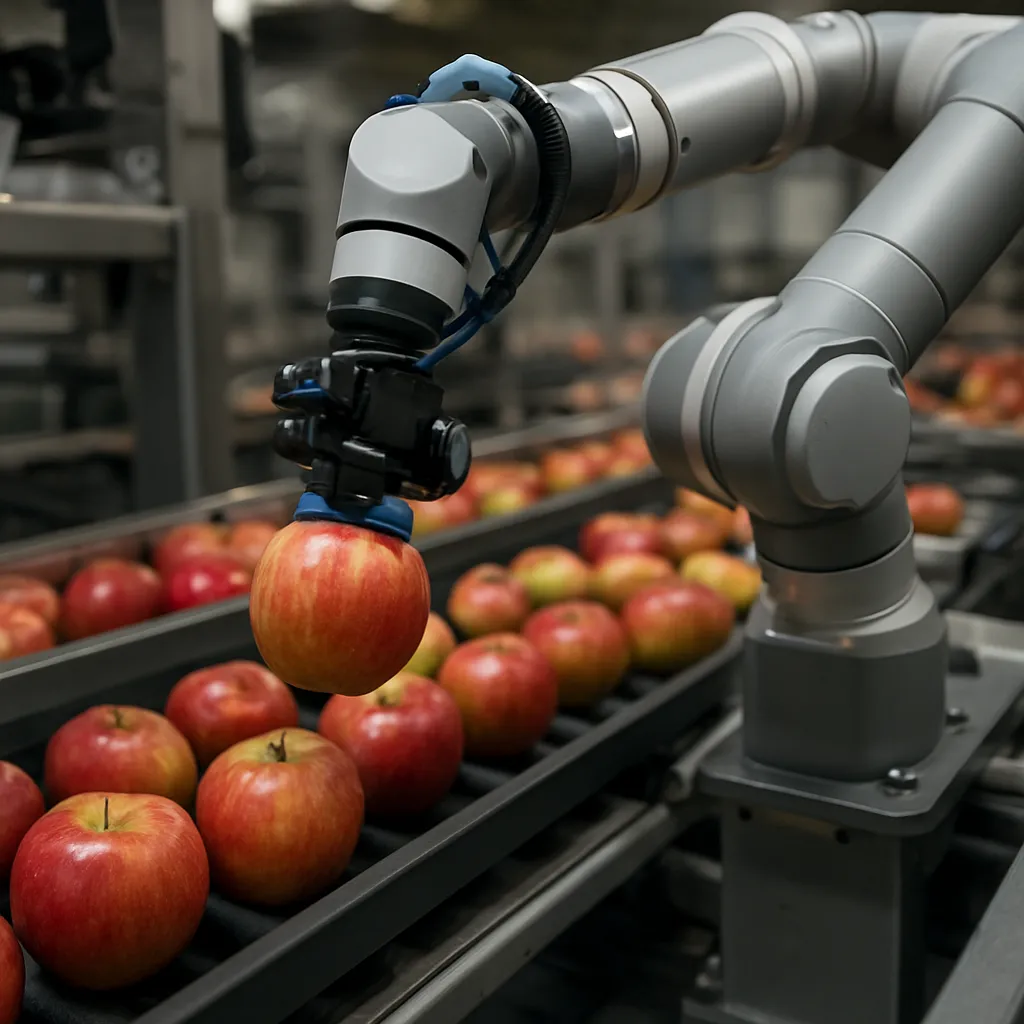
Once designated for a particular grade, fruits are redirected by precise robotic arms or air-jet actuators. Modern grippers blend soft-material contact surfaces with force-sensing controls to prevent bruising. Highlights include:
- Multi-axis robotic arms that adjust pick-and-place speed instantly
- Vacuum-cup or gentle-finger end effectors tailored to different fruit types
- High-cycle reliability, enabling continuous operation 24/7
By integrating motion planning and collision avoidance software, these robots navigate crowded sorting lanes without interrupting the flow.
Impact on Productivity and Quality Assurance
Implementing robotic sorting yields substantial benefits across the supply chain. Key performance improvements are:
- Efficiency: Throughputs exceeding 5,000 fruits per minute in large-scale facilities
- Precision: Grading accuracy above 98%, reducing mixed-grade shipments
- Consistency: Uniform grading decisions regardless of shift changes or inspector availability
- Traceability: Each fruit can be tracked via barcode or RFID, linking to harvest data, sorting logs, and distribution channels
Additionally, real-time data analytics dashboards allow managers to monitor defect rates, identify seasonal trends, and adjust harvest or sorting parameters swiftly. The net result is reduced waste, improved consumer satisfaction, and higher margins for growers and packers.
Challenges and Future Directions
Despite rapid progress, several hurdles remain before robotic fruit sorting reaches its full potential:
- High initial capital expenditure, which can deter small-scale farms
- Complex integration with existing packing lines and legacy equipment
- Variability in fruit presentation—such as clustering or overlapping—can confuse vision systems
- Need for ongoing maintenance and calibration to ensure optimal performance
Looking forward, research focuses on enhancing sustainability and flexibility. Innovations under development include:
- Modular, mobile sorting units deployable at remote orchard sites
- Edge computing architectures for on-device AI inference, reducing network dependency
- Bio-inspired soft robotics that conform seamlessly to delicate produce shapes
- Integrated nutrient or pesticide residue sensors for end-to-end food safety verification
By marrying cutting-edge robotics with precision agriculture philosophies, the fruit industry stands poised for a new era of resource-efficient, data-driven operations that meet the demands of global markets while minimizing environmental impact.